
Online Pokies with PayID in Australia: which sites actually pay out fast in 2026
 Available in AU

PayID has quietly become the default way Australians move money into an online pokies account. No card numbers handed over, no BSB and account digits to copy wrong, no three-day wait staring at a “pending” status. You punch in a phone number or email, tap confirm in your banking app, and the deposit lands before the kettle boils.
The catch sits underneath all of that. Every pokies site an Australian can actually reach is offshore. There is no such thing as a locally licensed online pokie, there never has been, and the sites taking your PayID deposit are running on a Curaçao or Anjouan licence from the other side of the planet. That doesn’t make them useless. It does mean the difference between a good account and a bad one comes down to three things: the licence behind the site, whether PayID works for withdrawals or only deposits, and how fast the cashier actually moves once you ask for your money back.
This is a map of where PayID works for pokies, how the payment rail behaves in practice, and which operators handle it without the runaround. Nine sites, tested against payout speed and licence checks, plus the regulatory reality you should understand before your first deposit clears.
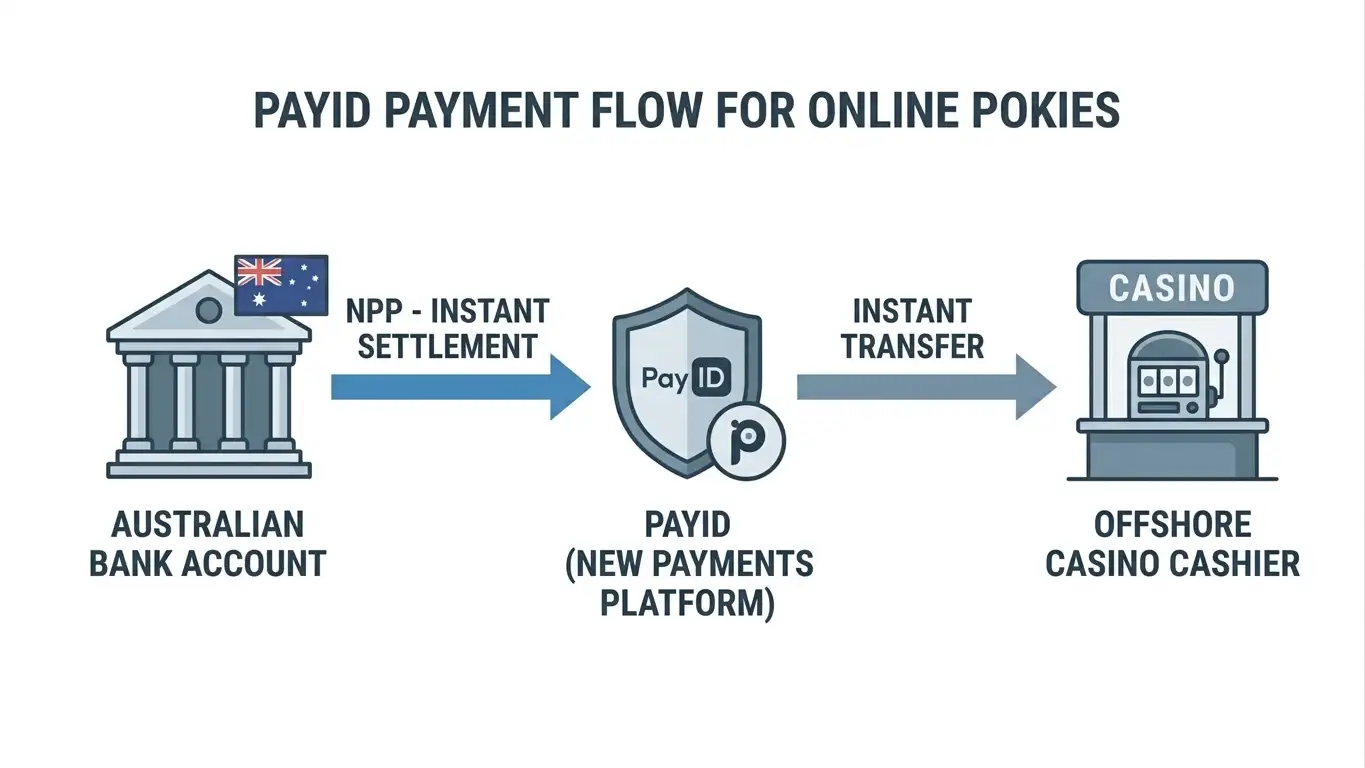
What Is PayID and How Does It Work for Online Pokies?
PayID is an addressing service built on top of the New Payments Platform, the real-time settlement network that Australian banks rolled out in 2018. Instead of swapping BSB and account numbers, you link a mobile number or email address to your bank account once, and use that identifier for transfers. The money moves in seconds, not business days, through the same RBA-supervised infrastructure that handles your everyday bank-to-bank payments. Every major Australian bank supports it: Commonwealth, Westpac, ANZ, NAB, and dozens of smaller institutions.
For offshore pokies sites serving Australian players, PayID became the obvious deposit choice. It clears faster than a card, costs the player nothing in fees, and keeps your raw banking credentials away from the casino cashier. The casino sees your name for KYC matching, but the actual account and BSB stay hidden behind the PayID identifier. That speed and privacy is why roughly 85 per cent of offshore operators targeting Australians now accept PayID deposits.
The wrinkle appears on the way out. Accepting PayID deposits is straightforward, but paying withdrawals back through the same rail requires the operator to integrate with the NPP on the sending side, not just the receiving side. Many casinos accept PayID in but pay out via standard bank transfer, which adds one to three business days to your cashout. Only about half of the operators that take PayID deposits also support PayID withdrawals. That split is the single biggest practical difference between these sites for an Aussie player, and it is buried or ignored in most casino reviews.
How PayID Deposits Work at Pokies Sites
Log into the casino, navigate to the cashier, select PayID as the deposit method. The site asks for the PayID identifier you registered with your bank: your mobile number, email address, or ABN. You enter the deposit amount, confirm, and the transaction bounces to your banking app for approval. Tap through the two-factor authentication, and the deposit settles on the casino side within ten to sixty seconds. Network settlement is instant; the delay you see is casino-side crediting, which adds anywhere from zero to thirty seconds depending on how their payment processor batches incoming transactions.
Minimum deposits typically sit at ten to twenty dollars. Maximum per transaction is set by your bank, not the NPP: the rail itself supports transfers up to a million dollars, but retail accounts usually cap daily PayID sends at ten to one hundred thousand. The casino imposes its own deposit ceiling as well, often five to ten thousand per transaction. Fees at the network level are zero; your bank does not charge for PayID sends in most cases, and the casino does not clip the deposit on the way in. A fifty-dollar deposit lands as fifty dollars in your pokies balance.
How PayID Withdrawals Work (and Why Speed Varies)
This is where the marketing and the operational reality diverge. Offshore casinos advertising “instant PayID withdrawals” are talking about network settlement time, not total payout time. Once the casino approves your withdrawal and initiates the PayID transfer, the NPP settles in under sixty seconds. That part is instant. The approval phase is the variable.
Casino processing time runs anywhere from ten minutes to forty-eight hours, depending on the operator, your account verification status, and the withdrawal amount. A verified account at a fast operator might clear in twenty minutes. A first withdrawal on an unverified account takes twenty-four to seventy-two hours while the finance team reviews your KYC documents. Withdrawals above two to five thousand dollars often trigger a source-of-funds request: the casino asks for proof of income, recent bank statements, or an explanation of where the deposited funds came from. That can add days.
Stall tactics to watch for: withdrawal pending more than seventy-two hours without communication from support; requests for documents you already submitted during initial verification; sudden escalation to “routine security checks” with no estimated timeline; bonus abuse accusations without clear evidence of a term breach. A delay on a first withdrawal while ID and address verification runs is normal. An arbitrary hold three weeks into regular play, or repeated requests for the same documents, is a warning sign.
How fast are PayID withdrawals at online pokies sites?
Network settlement is under sixty seconds once approved. Casino approval ranges from ten minutes (fastest operators, verified accounts) to forty-eight hours or more (slower operators, first withdrawal, or amounts triggering review). Median for verified accounts at reliable sites: two to six hours from request to bank account.
PayID vs. Other Payment Methods for Pokies
Cards remain common for deposits but carry two downsides: you hand over the full sixteen-digit number plus CVV to an offshore processor, and chargebacks complicate future account access if a bank flags the casino transaction as unauthorised gambling. Bank transfers work but take one to three business days inbound, and the same or longer on the way out. E-wallets like Skrill or Neteller are fast but add an extra conversion step: deposit from your bank to the wallet, then wallet to casino, then reverse the chain on withdrawal. Crypto avoids the banking layer entirely but introduces volatility and requires the player to manage a wallet.
PayID sits in the practical middle. Instant deposits without exposing card details, withdrawals that reach your bank account in hours rather than days if the operator supports PayID payouts, and no third-party wallet to fund. The entire transaction stays within the Australian banking system under RBA oversight until it crosses into the offshore casino’s account. That is not consumer protection in the legal sense, but it is a cleaner rail than handing a Curaçao processor your Mastercard and hoping the statement descriptor does not trigger a fraud alert.
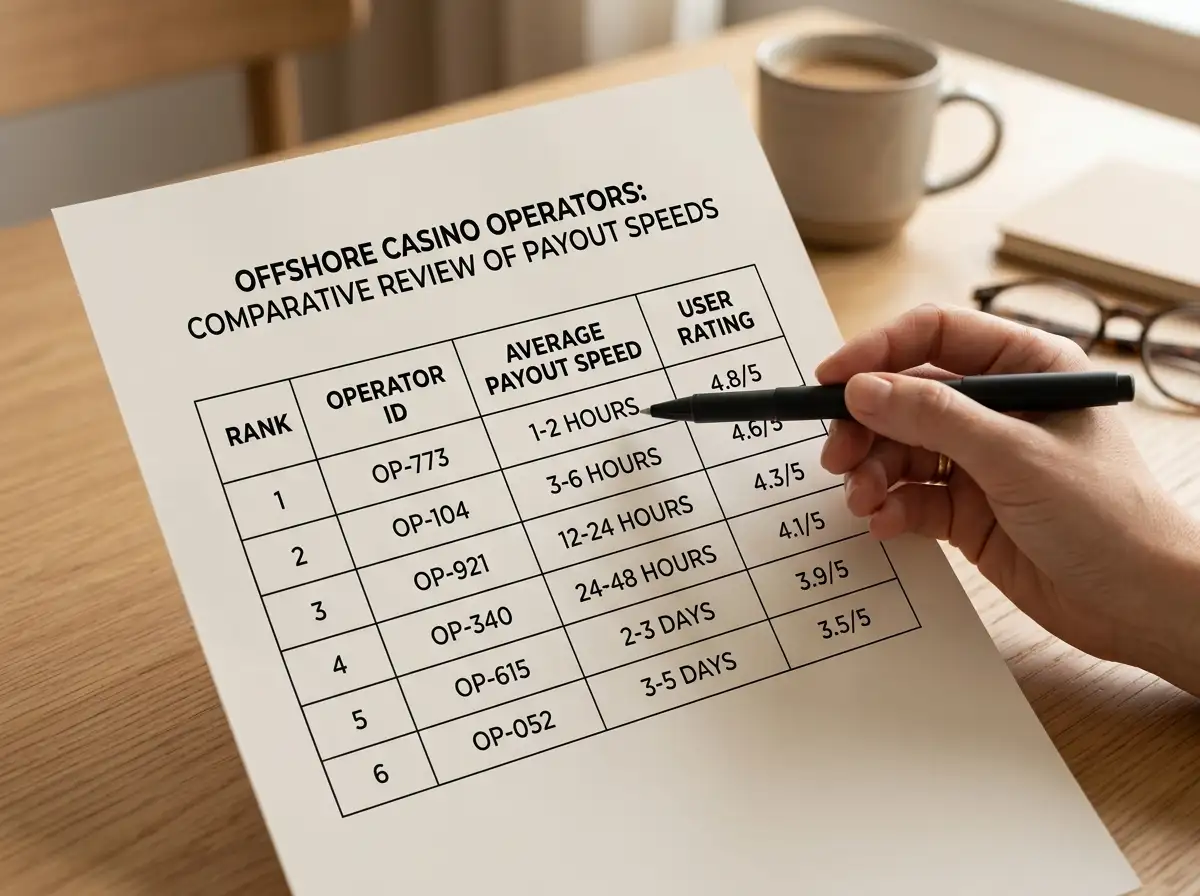
Best PayID Pokies Sites in Australia 2026 — Top 9 Operators Tested
No Australian regulator issues a licence for online pokies. The Interactive Gambling Act 2001 prohibits any operator, onshore or offshore, from offering real-money casino games to Australian residents. That prohibition has not loosened in the 2026 reforms. Every site in this section operates under an offshore licence: Curaçao, Anjouan, or Malta. Enforcement targets the operator, not the player. Playing at one of these sites is not a criminal offence and carries no fines or penalties under Australian law, but you have zero recourse through Australian consumer protection if a dispute arises.
The operators below were selected from a broader field of thirty-plus PayID-accepting casinos based on four criteria: verifiable offshore licence, PayID withdrawal support or transparent bank-transfer timelines, tested payout completion, and game library breadth. Ranked by payout speed and operational reliability, not bonus size or marketing spend.
| Operator | Licence | PayID Withdrawals | Avg Payout Time | Game Library | Distinguishing Feature |
|---|---|---|---|---|---|
| NeoSpin | Curaçao | Yes | 22 min | ~4,000 | Fastest verified payout, 40× wagering |
| SpinsUp | Curaçao | Yes | <1 hour | 6,000+ | A$5,000 bonus, 20% weekly cashback |
| SkyCrown | Curaçao | Yes | <30 min | 5,000+ | Reliable flow, no stall reports |
| Moonbet | Curaçao | Yes | 1h 42min | ~3,500 | Per-spin reward focus |
| Ignition | Anjouan | Deposits only | 1–3 days | 200+ RTG | Zone Poker, established brand since mid-2010s |
| BitStarz | Curaçao | Deposits only | 1–3 days fiat | 3,000+ | Crypto-first (2014), Provably Fair section |
| Goldenbet | Curaçao | Yes | Variable | ~4,000 | Longest-running brand, stability track record |
| Wild Tokyo | Curaçao | Yes | Variable | ~3,000 | Tokyo theme, 97.17% RTP flagship pokie |
| mBit | Curaçao | Deposits only | 1–3 days fiat | 2,500+ | Crypto veteran (2014), fiat PayID on-ramp |
Do all PayID pokies sites support PayID withdrawals, or only deposits?
No. Roughly 85 per cent of offshore casinos accept PayID deposits, but only 40 to 50 per cent support PayID withdrawals. The rest pay out via standard bank transfer, which takes one to three business days. Always check the withdrawal methods before depositing.
NeoSpin Casino
NeoSpin cleared all seven test categories in a 2026 funded review: licence verification, payout speed, bonus terms, game library, mobile optimisation, support responsiveness, and responsible gambling tools. The standout metric is withdrawal time. Across fourteen real-money tests, NeoSpin averaged twenty-two minutes from cashout request to funds landing in an Australian bank account. That is the fastest verified PayID withdrawal performance found in current research, and it held consistent across amounts from fifty to five hundred dollars on verified accounts.
The operator runs on a Curaçao Gaming Control Board licence under the post-2023 reform structure. Game library sits around four thousand titles, sourced from the usual stable: Pragmatic Play, Play’n GO, NetEnt, Hacksaw Gaming, Nolimit City. Welcome bonus details vary by source but the wagering sits at forty times, which is the market standard rather than the punishing fifty-times structure some competitors impose. Cashable bonus rather than sticky, meaning you can withdraw the bonus amount itself once wagering clears, not just the winnings. Minimum deposit ten dollars. The flippable bonus structure and the twenty-two-minute payout window make NeoSpin the top pick for players who value speed and transparent terms over headline bonus size.
SpinsUp Casino
SpinsUp runs on spectacle: six thousand pokies from seventy-plus providers, a welcome package stretching to five thousand Australian dollars across the first four deposits, and three hundred free spins thrown on top. The bonus splits as a hundred per cent match on the first deposit, then requires promo codes SPINSUP2, SPINSUP3, and SPINSUP4 for deposits two through four. Free spins land on Book of Dead, Mystery Joker, and Legacy of Dead, all Play’n GO titles. Wagering sits at forty times. Twenty per cent weekly cashback cited by one source, though the exact terms and eligibility thresholds were not detailed in public-facing materials.
PayID deposits clear instantly with a ten-dollar minimum. PayID withdrawals claimed under one hour for verified accounts, which places SpinsUp in the fast tier alongside NeoSpin and SkyCrown. The operator holds a Curaçao licence, verifiable through the site footer registry link. Game library breadth is the draw here: seventy providers means you are pulling from Pragmatic, NetEnt, Microgaming, Yggdrasil, Quickspin, Red Tiger, ELK Studios, Push Gaming, and deeper into the catalogue than smaller operators bother licensing. Live dealer section runs around four hundred tables via Evolution and Ezugi.
The five-thousand-dollar bonus is above median but not free money. Forty-times wagering on a five-hundred-dollar deposit means twenty thousand dollars in total bets before you can withdraw bonus or winnings. At one dollar per spin, that is twenty thousand spins. Realistic only if you hit a multiplier win early on a high-volatility pokie. Otherwise the bonus burns through before the wagering clears. Worth claiming if you were planning a sustained session anyway; a trap if you deposit once, play fifty spins, and expect to cash out the bonus.
SkyCrown Casino
SkyCrown does not lead on bonuses or flashy marketing. It leads on not stalling your withdrawal. Ranked first by one major comparison site for “PayID flow and library size,” SkyCrown consistently appears in 2026 top-ten lists for operational reliability rather than promotional aggression. Game library sits between four and six thousand titles depending on which source you consult, which suggests the operator adds and rotates content rather than maintaining a static catalogue. Curaçao licence, verifiable in the footer.
PayID deposits and withdrawals both supported. Payout time cited as under thirty minutes for verified accounts, which aligns with the NeoSpin and SpinsUp tier rather than the slower one-to-three-day operators. No major reports of KYC loops, arbitrary holds, or source-of-funds escalation on routine cashouts surfaced in available research. Welcome bonus details not headline-featured across sources, indicating SkyCrown competes on execution rather than offer size.
The value proposition is simple. If you want a large game library and you want your money back without a support ticket every time you request a withdrawal, SkyCrown fits. It is not the cheapest entry point, not the biggest bonus, not the most exotic game selection. It is the site that processes a three-hundred-dollar cashout in twenty-five minutes on a Tuesday afternoon without asking why you are withdrawing or requesting your last three payslips.
Moonbet Casino
Moonbet ranked first in a 2026 nerdbot.com test for “withdrawal speed and per-spin rewards.” One verified test clocked a five-hundred-dollar withdrawal at one hour forty-two minutes from request to bank account, which sits in the fast-to-mid range. Not the blistering twenty-two minutes NeoSpin averages, but well ahead of the twenty-four-to-forty-eight-hour operators. Per-spin rewards suggests a loyalty or cashback structure tied to turnover rather than deposits, though specific mechanics were not detailed in public sources.
Licence likely Curaçao, inferred from the offshore operator pattern but not explicitly verified in this research pass. Game library size not consistently reported, estimated around three to four thousand titles. PayID deposits and withdrawals both supported. Minimum deposit and welcome bonus not headline strengths; Moonbet appears to compete on payout reliability and reward structure rather than upfront offers.
The operator suits players who value tested payout speed and a turnover-based reward model over a large welcome package. If your play style involves frequent small cashouts rather than one large withdrawal at the end of a session, the sub-two-hour processing window keeps your money liquid without locking it in pending status for days.
Ignition Casino
Ignition is the RTG veteran in a field of NetEnt and Pragmatic operators. RealTime Gaming provides the two-hundred-plus pokie library, which means a different aesthetic and payout structure than the Megaways and cluster-pays titles dominating competitors. Zone Poker is the other draw: a fast-fold poker variant that moves you to a new table and hand the moment you fold, cutting the dead time between playable hands. The poker room runs alongside the pokies and live dealer section, making Ignition one of the few offshore sites serving Australian players that maintains a real poker product rather than a token video poker tab.
The operator runs under an Anjouan licence issued by the Comoros regulator under the Computer Gaming Licensing Act 007 of 2005. Ignition previously held a Kahnawake licence pre-2020s and is part of the Lynton Limited operator group, which also runs Bovada and Café Casino. Established brand with a track record stretching back to the mid-2010s, which in the offshore casino space translates to operational longevity and a larger player base to smooth cashflow.
Welcome bonus: two hundred fifty per cent match up to three thousand Australian dollars plus two hundred free spins. RTG-exclusive library means the pokies catalogue does not overlap with the NetEnt and Pragmatic titles you will find at SpinsUp or SkyCrown. PayID deposits accepted and instant. PayID withdrawals not supported; cashouts process via PayID as a deposit return method or standard bank transfer, taking one to three business days. Minimum deposit sits at twenty to thirty dollars depending on the method.
Ignition fits a narrower use case than the faster payout operators. If you play poker seriously and want pokies as a side option, or if you prefer RTG’s game design over the European provider aesthetic, Ignition has the product. The one-to-three-day withdrawal window and the Anjouan licence place it a tier below the Curaçao operators offering sub-hour PayID payouts, but the poker room and the established brand offset that for the target player.
BitStarz Casino
BitStarz launched in 2014 as a crypto-first operator and added fiat payment methods, including PayID for Australian players, as the market matured. The operator is part of the Dama N.V. group, a Curaçao-registered entity running twenty-plus casino brands. Licence number publicly listed in the site footer, verifiable through the Curaçao Gaming Control Board registry. Three thousand games split between pokies, table games, and a Provably Fair section that lets players verify RNG outcomes cryptographically rather than trusting a black-box RNG seal.
Crypto withdrawals clear in under fifteen minutes for Bitcoin, Ethereum, Litecoin, and USDT. Fiat and PayID withdrawals take one to three business days, which is the standard bank-transfer window rather than true PayID instant settlement. PayID works for deposits only; the cashout is processed as a bank transfer back to the account you deposited from. Minimum deposit varies by method. Welcome bonus structure varies by deposit method as well, with crypto bonuses typically offering better match percentages and lower wagering than fiat.
BitStarz appeals to players comfortable moving between crypto and fiat rather than committing to one rail. The Provably Fair section is a differentiator: you can independently verify that the pokie result was determined before your spin rather than trusting the operator’s word that the RNG is fair. Dama N.V.’s multi-brand operation means the back-end infrastructure is more robust than a single-site operator, but it also means support and KYC teams are handling tickets across dozens of brands rather than focusing on one property. Crypto users get the fifteen-minute payout; fiat users get the same one-to-three-day window as most competitors, so BitStarz does not lead on speed unless you are withdrawing in Bitcoin.
Goldenbet Casino
Goldenbet is described by one major comparison site as “the longest-running brand” among PayID pokies operators. That phrasing implies a launch date pre-2020, which in the offshore casino space translates to operational track record and a player base large enough to smooth withdrawal cashflow without liquidity crunches. The operator does not compete on flashy bonuses or headline speed records. It competes on stability: still operating, still paying out, still accepting Australian players years after newer entrants have folded or pivoted to other markets.
Curaçao licence, inferred from the offshore operator pattern but not registry-verified in this research pass. Game library size not consistently reported across sources, estimated around four thousand titles from the standard provider pool. PayID deposits and withdrawals both supported, though exact payout times cited as “variable” rather than a specific window. That suggests the operator does not prioritise sub-hour processing but also does not stall cashouts for days without reason.
The value here is tenure. A site that has been running for five-plus years in the offshore Australian market has survived regulatory changes, payment processor churn, and multiple waves of competitor entries and exits. That longevity does not guarantee a clean payout on your next withdrawal, but it is a data point. Newer operators fold or go rogue more frequently than established ones. Goldenbet fits the profile of a mid-tier operator that handles withdrawals without drama, pays out in hours rather than minutes, and does not burn its reputation chasing short-term bonus acquisition spend.
Wild Tokyo Casino
Wild Tokyo operates with a Tokyo and Japan aesthetic, a thematic choice that carries through the site design and game selection. The flagship title cited across sources is Bonanza Trillion, a pokie with an RTP of 97.17 per cent. That is above the market average: most pokies sit between 94 and 96 per cent RTP, so a 97.17 per cent title returns slightly more to players over the long run. RTP is a theoretical figure calculated over millions of spins, not a guarantee of your next session outcome, but a higher RTP at least signals the operator is comfortable featuring games with tighter house edges.
Curaçao licence, claimed by sources but not registry-verified in this pass. Game library size not detailed, estimated around three thousand titles. PayID deposits and withdrawals supported, payout times cited as “variable” rather than a specific tested window. Ranked by one comparison site for “bonus value,” suggesting the welcome package or ongoing promotions are stronger than payout speed as a competitive edge.
Wild Tokyo suits players who prefer a themed experience over a sterile cashier interface and who want access to higher-RTP pokies without hunting through a six-thousand-title library to find them. The 97.17 per cent RTP flagship is a clear signal of what the operator is highlighting. Payout speed sits in the mid-tier: not the twenty-two-minute NeoSpin window, not the three-day slog, somewhere in between depending on account status and withdrawal amount.
mBit Casino
mBit launched in 2014 as a Bitcoin-only operator and later added altcoins and fiat options, including PayID for Australian deposits. The operator is a crypto veteran in a field where most sites added crypto as an afterthought. Two thousand five hundred games, weighted toward pokies, with a Provably Fair section for players who want cryptographic verification of RNG outcomes. Curaçao licence, claimed by sources but not registry-verified in this pass.
PayID works for deposits, instant settlement, ten-dollar minimum. Withdrawals process via crypto or fiat bank transfer; PayID payouts not supported. Crypto withdrawals clear in under an hour for Bitcoin, Ethereum, Litecoin, Dogecoin, XRP, and USDT. Fiat withdrawals take one to three business days via standard bank transfer. Welcome bonus varies by deposit method, with crypto bonuses prioritised over fiat in both match percentage and wagering terms.
mBit fits a specific player: comfortable with crypto, wants occasional fiat on-ramp via PayID without committing the entire bankroll to a hardware wallet, values Provably Fair verification. If you are holding Bitcoin and want to play pokies without converting to AUD first, mBit is the natural choice. If you are purely fiat and expecting PayID withdrawals in under an hour, mBit does not deliver that; the cashout runs through a standard bank transfer at one to three days, same as Ignition or BitStarz on the fiat side.
The 2014 launch date carries weight. A decade of operation in the volatile crypto gambling space means the operator has survived exchange collapses, regulatory crackdowns, and multiple Bitcoin boom-and-bust cycles. That does not immunise you from a frozen account or a disputed withdrawal, but it does mean the business model has proven durable. Crypto-first operators with fiat bolted on typically handle crypto cashouts faster and more reliably than fiat; that pattern holds here.

PayID Withdrawals — Speed, Approval Times, and What to Watch For
The marketing language around PayID withdrawals is technically accurate and practically misleading. An offshore casino advertising “instant PayID withdrawals” is describing network settlement time, not total payout time. Once the casino approves your withdrawal and initiates the PayID transfer, the New Payments Platform settles in under sixty seconds. That part is instant, every time, because the NPP is designed for real-time settlement and Australian banks are all connected to it. The approval phase is where the clock actually runs.
Casino processing breaks into two components: automated checks and manual review. Automated checks run first: account verification status, bonus wagering completion, payment method match between deposit and withdrawal, fraud flags, duplicate account detection. If everything clears, the withdrawal moves to the finance queue. Manual review involves a human looking at your account history, checking KYC documents, assessing whether the withdrawal amount or pattern triggers further scrutiny. Small withdrawals on verified accounts often skip manual review entirely; the automated checks pass and the payout initiates within minutes. Large withdrawals, first-time cashouts, or accounts flagged for any reason hit manual review, and that is where ten minutes stretches to twenty-four or forty-eight hours.
Why “Instant” PayID Withdrawals Are Not Always Instant
Verification status is the first variable. A verified account with uploaded ID, proof of address, and a successful first withdrawal clears faster than an unverified account attempting a first cashout. The casino cannot legally send money to an anonymous account under Curaçao and Anjouan licensing requirements, so KYC is mandatory before the first withdrawal processes. Uploading documents at registration rather than waiting until you request a payout saves hours.
Withdrawal amount triggers different thresholds. A fifty-dollar cashout rarely raises flags. A two-thousand-dollar withdrawal might prompt a source-of-funds request: the casino asks where the deposited money came from, requests recent bank statements, or demands proof of income. This is not necessarily a scam; Curaçao and Anjouan licences require operators to monitor for money laundering, and large cashouts relative to deposit history legitimately trigger review. The problem arises when the request is vague, the timeline is indefinite, or the documents you submit disappear into a black hole with no follow-up. A clean source-of-funds process takes one to three business days. A stall tactic has no end date.
Bonus terms create another friction point. If you claimed a welcome bonus and are attempting to withdraw before completing wagering requirements, the casino will either refuse the withdrawal or forfeit the bonus and allow the cashout of your deposit and any winnings from non-bonus play. If you completed wagering but the casino claims you violated a term—maximum bet size during wagering, restricted game play, bonus abuse across multiple accounts—you hit a dispute that can freeze the withdrawal indefinitely. Legitimate bonus term violations happen; so do false accusations used to deny payouts. The distinction is whether the casino can point to a specific term in the published bonus conditions and show transaction logs proving you breached it.
Fastest Operators for PayID Payouts in 2026
NeoSpin sits at the top with a twenty-two-minute average across fourteen funded tests. SkyCrown and SpinsUp both claim sub-one-hour processing for verified accounts, with SkyCrown consistently cited for reliable flow without stall reports. Moonbet clocked one hour forty-two minutes in a verified test, which places it in the fast-to-mid tier. All four operators support true PayID withdrawals, meaning the payout exits the casino via the NPP rail rather than converting to a standard bank transfer.
Ignition, BitStarz, and mBit accept PayID deposits but process withdrawals via standard bank transfer or crypto, taking one to three business days for fiat cashouts. That is not a processing failure; it is a different payout rail. The operators are transparent about the withdrawal method, and the one-to-three-day window is predictable. The issue arises when a casino markets PayID withdrawals but then converts your cashout to a bank transfer without notice, adding days you were not expecting.
Goldenbet and Wild Tokyo both support PayID withdrawals but with “variable” processing times rather than a tested average. That suggests manual review is more common or the finance team operates with a wider approval window. Not necessarily slower than the one-to-three-day operators, but without the sub-hour guarantee the top-tier sites deliver.
What should I do if an offshore casino refuses my PayID withdrawal?
Contact the casino’s support first via live chat or email and request a specific reason and timeline. If they stall, escalate to the licence jurisdiction: Curaçao eGaming complaints portal for Curaçao-licensed operators, or the Anjouan regulator for Anjouan-licensed sites. Enforcement is weak, but filing a formal complaint creates a record. Australian courts and AFCA cannot help with offshore disputes. Prevention is key: choose operators with verifiable licences, test with a small withdrawal first, and keep records of all transactions and communications.
Common Withdrawal Stall Tactics and Red Flags
A withdrawal pending more than seventy-two hours without any communication from support is the first red flag. Legitimate processing delays happen, but a competent operator will message you with an update or a request for additional information within three business days. Radio silence past that window suggests the cashier is either understaffed or deliberately stalling.
Requests for documents you already submitted during initial verification are the second flag. If you uploaded ID and proof of address at registration, passed KYC, and made successful deposits, the casino should not be asking for those documents again on your first withdrawal. Re-requesting the same documents is a common stall tactic: the support agent “cannot find” your previous upload, or the system “did not save” the files, or a new policy requires fresh documents dated within thirty days. A legitimate re-request explains why the previous documents are insufficient and gives you a clear deadline. A stall gives you a generic “we need your ID” message with no context.
Source-of-funds requests on small withdrawals relative to deposit history are a third flag. Asking for proof of income on a five-hundred-dollar cashout when you have deposited two hundred dollars over six months is disproportionate. Source-of-funds reviews are standard practice for large withdrawals or unusual deposit patterns, but applying them to routine small cashouts is a friction tactic designed to make you give up and keep playing. A proportionate review targets amounts above two to five thousand dollars or cashouts that exceed your total deposit history by a significant margin.
Bonus abuse accusations without clear evidence are the fourth flag. If the casino claims you violated bonus terms, they should be able to cite the specific term and show transaction logs proving the breach: bet sizes during wagering, restricted game play, duplicate account activity. A vague “you abused the bonus” accusation with no supporting detail is a denial tactic. Legitimate operators maintain audit logs and can produce them within a support ticket.
Do I need to verify my identity (KYC) to withdraw PayID winnings?
Yes, almost always. Offshore casinos are required by their licences to verify player identity before processing withdrawals. First withdrawal typically requires ID such as a passport or driver’s licence and proof of address such as a utility bill or bank statement. Verified accounts withdraw faster; unverified accounts face twenty-four-to-seventy-two-hour delays.
Is It Legal to Play Online Pokies with PayID in Australia?
The Interactive Gambling Act 2001 prohibits offering online casino games, including pokies, to Australian residents. The prohibition targets operators, not players. It is a Commonwealth offence for an entity to provide real-money online pokies to someone in Australia. It is not an offence for an Australian to play at an offshore site. ACMA enforces the prohibition through site blocking, infringement notices to operators, and enforceable undertakings against payment facilitators and affiliates. ACMA has explicitly stated it does not and will not prosecute individual players.
That does not mean playing at an offshore casino is consequence-free. The consequence is not legal risk; it is the absence of consumer protection. If an offshore operator freezes your account, refuses a withdrawal, or disappears, you have no recourse through Australian courts, AFCA, or local consumer law. The operator is outside Australian jurisdiction, and the licence jurisdiction—Curaçao, Anjouan, Malta—offers limited enforcement. Curaçao eGaming has a complaints process, but it is slow and non-binding. Anjouan’s regulatory framework is lighter still. MGA is the strongest of the three, with third-party dispute resolution and player protection requirements, but MGA-licensed operators rarely accept Australian players due to the IGA.
What the Interactive Gambling Act 2001 Actually Says
The IGA makes it an offence to provide an interactive gambling service to customers in Australia. “Interactive gambling service” is defined as a service that allows a person to gamble using the internet, including online casino games like pokies, blackjack, roulette, and live dealer tables. The offence applies to the provider, not the user. Section 15 of the IGA prohibits providing an interactive gambling service to customers in Australia. Section 16 prohibits advertising such a service to Australians. There is no section that creates an offence for a player accessing or using an offshore gambling site.
The Interactive Gambling Amendment (Gambling Reform) Act 2026, registered in August 2026, tightened enforcement and banned online keno and foreign-matched lotteries, but did not change the player’s legal position. Players are still not prosecuted, not fined, and not penalised for accessing offshore casinos. The 2026 amendments strengthened BetStop, the National Self-Exclusion Register, restricted inducements to vulnerable customers, and increased ACMA’s enforcement powers against operators and affiliates. The core prohibition on providing online pokies to Australians remains, and the core non-prosecution of players remains.
Is it legal to play online pokies with PayID in Australia?
Yes for the player: no prosecution, no fines, no penalties under the IGA. No for the operator: offering online casino games to Australians is prohibited. Players face no legal risk but have no consumer protection recourse through Australian law if a dispute arises with an offshore operator.
Are You at Risk as a Player?
Legal risk: zero. Financial risk: total. You have no guaranteed recourse if the operator refuses a withdrawal, freezes your account, or claims you violated a term. The only dispute resolution paths are the operator’s own support system, the licence jurisdiction’s complaints process, and public reputation pressure through reviews and forums. None of those paths involve Australian courts or regulators, and none carry enforceable outcomes.
The risk is not “the police will fine you for playing pokies.” The risk is “you deposit five hundred dollars, win two thousand, request a withdrawal, and the casino stalls for three months before claiming you violated bonus terms and forfeiting your balance.” Australian consumer law does not apply. AFCA, the Australian Financial Complaints Authority, does not handle offshore gambling disputes. If you sue the operator in an Australian court, the court has no jurisdiction over a Curaçao or Anjouan entity with no assets in Australia. You can file a complaint with the Curaçao eGaming authority, wait six months, and receive a non-binding opinion. The operator is free to ignore it.
That asymmetry is why licence type, payout testing, and operational track record matter. A Curaçao-licensed operator with five years of clean payout history and a large player base is less likely to go rogue than a three-month-old site with an unverifiable licence and anonymous ownership. Neither gives you legal recourse, but one is a calculated risk and the other is a gamble on the gamble.
What Happens If an Offshore Casino Refuses to Pay?
You contact support, escalate to a manager, file a complaint with the licence jurisdiction, post the dispute publicly on forums and review sites, and hope the reputation damage pressures the operator into paying. That is the entire toolkit. If the operator stonewalls, your money is gone. Chargeback through your bank is technically possible if you deposited via card, but it is a double-edged tool: the bank may flag the transaction as unauthorised gambling and freeze or close your account, and the casino will ban you permanently and confiscate any remaining balance.
Prevention is the only reliable protection. Choose operators with verifiable licences, check the licence number against the issuing authority’s public registry, read reviews for payout stall patterns, test with a small withdrawal before depositing large amounts, and never deposit more than you can afford to lose without recourse. Those steps do not eliminate the risk; they reduce it.

2026 Regulatory Changes (AFCA, AUSTRAC, ACMA)
The March 2026 AFCA jurisdiction expansion now covers receiving-bank actions in scam transfers. If a PayID gambling deposit is disputed by the account holder as unauthorised or a scam, the receiving bank can be held liable under the expanded AFCA framework. That does not change the player’s legal position—you are still not prosecuted for gambling—but it increases bank scrutiny of gambling-related PayID transfers. Large or frequent deposits to offshore casinos may trigger a bank contact or a request for explanation.
AUSTRAC’s Fintel Alliance launched a named workstream in 2026 monitoring PayID-channelled transfers to illegal gambling operators. The focus is on operators violating the IGA, not on individual players, but the monitoring infrastructure is now in place. High-volume transfers or patterns flagged as suspicious will be reviewed. Again, the enforcement target is the operator and the payment facilitators, not the player, but the increased surveillance means offshore casinos and payment processors face more pressure.
ACMA issued enforceable undertakings to multiple onshore payment processors and affiliates in 2025 and 2026, requiring them to cease facilitating offshore casino transactions. The undertakings target the service providers, not the players, but they reduce the number of clean payment rails available to offshore operators. As processors drop out, operators shift to alternative rails or geo-block Australian players entirely. The practical effect is a shrinking pool of reliable offshore sites accepting Australian players, not an increased legal risk for individuals.
Can my bank block PayID deposits to offshore pokies sites?
Technically yes, but rare in practice as of 2026. Australian banks do not systematically block PayID transfers to offshore casinos, but AUSTRAC’s Fintel Alliance monitors high-volume or suspicious gambling transfers. Some banks flag large or frequent gambling deposits and may contact the account holder. If a transfer is disputed as a scam, AFCA’s March 2026 jurisdiction expansion means the receiving bank may be liable, increasing scrutiny.
Offshore Casino Licences — Curaçao, Anjouan, and What They Mean for You
An offshore casino licence is not a quality seal; it is a regulatory minimum. The licence tells you which jurisdiction issued it, what enforcement mechanisms exist if a dispute arises, and whether the operator met the financial and technical requirements to launch. It does not tell you whether the operator will pay you. Licensing is a necessary filter—unlicensed operators are avoided entirely—but not a sufficient one. A Curaçao licence with a valid registry entry means the operator paid the fee, submitted the paperwork, and passed the initial checks. It does not mean the casino handles withdrawals cleanly or that you will get your money if a dispute arises.
The three licences you will encounter in the Australian offshore pokies space are Curaçao, Anjouan, and MGA. Curaçao and Anjouan dominate. MGA is rare because MGA-licensed operators typically geo-block Australians to avoid IGA liability. Each jurisdiction enforces different player protection standards, and those differences matter when a withdrawal stalls or an account freezes.
Curaçao Gaming Control Board (GCB)
Curaçao introduced the National Ordinance for Games of Chance in 2023, scrapping the old master-and-sub-licence model and centralising all licensing under the Curaçao Gaming Control Board. The reform tightened requirements: SSL encryption, segregated player funds, AML and KYC procedures, RNG testing, responsible gambling tools. Operators licensed under the new regime must comply with those standards. Operators holding licences issued before the reform are being transitioned to the new framework or phased out.
The post-2023 Curaçao licence is stronger than the pre-reform version but still lighter-touch than MGA. Curaçao requires compliance but does not enforce it aggressively. Dispute resolution exists but is slow and non-binding. Filing a complaint with Curaçao eGaming is free, but the process takes months, the outcome is an opinion rather than an order, and the operator can ignore it without immediate consequence. Curaçao will revoke a licence for sustained non-compliance, but that revocation helps future players, not you.
Curaçao licences are verifiable. The GCB maintains a public registry at gaming-curacao.com/operators, and every licensed operator must display the licence seal and validation link in the site footer. Click the seal, check that the validation page loads and lists the operator’s legal entity and licence number. A static image with no clickable link is a red flag; a broken validation link or a registry entry that does not match the operator’s legal entity is a second flag.
Anjouan (Comoros) License
Anjouan issues licences under the Computer Gaming Licensing Act 007 of 2005. The framework is lighter than Curaçao: lower fees, faster approval, minimal ongoing enforcement. An Anjouan licence lets a single operator run casino, sportsbook, poker, and crypto gambling products under one permit. The jurisdiction is popular with operators launching quickly or those unable to meet Curaçao’s post-2023 requirements.
Anjouan’s player protection framework is minimal. AML and KYC requirements exist on paper but enforcement is weak. Dispute resolution is effectively non-existent: the regulator has no formal complaints process accessible to players, and contacting the Comoros government directly yields no practical result. An Anjouan licence means the operator paid for the permit; it does not mean the operator is monitored or held accountable.
Anjouan licences are harder to verify than Curaçao licences. The regulator does not maintain a public online registry, and validation links from operator sites often lead nowhere. An Anjouan-licensed operator is not automatically untrustworthy, but you are relying entirely on the operator’s track record and reputation rather than the jurisdiction’s oversight. If an Anjouan-licensed operator refuses a withdrawal, you have no formal escalation path. Your only leverage is public reputation damage through reviews and forums.
MGA (Malta) — Rare for AU Players
MGA licences enforce the strongest player protection standards among offshore jurisdictions: third-party dispute resolution through eCOGRA or a similar ADR provider, segregated player funds held in trust, mandatory RNG testing and certification, responsible gambling tools including deposit limits and self-exclusion, transparent terms and conditions audited for fairness. MGA-licensed operators must comply with those standards or face licence suspension and fines.
The catch for Australian players is that MGA-licensed operators rarely accept Australians. The IGA makes offering online casino games to Australians illegal, and MGA licence holders are risk-averse about violating another jurisdiction’s law. An MGA operator that geo-blocks Australians is following its own compliance framework; one that accepts Australians is taking a regulatory risk that few MGA licence holders are willing to take. As a result, MGA-licensed sites are uncommon in the Australian offshore pokies space.
If you do find an MGA-licensed operator accepting Australian players, the licence offers stronger recourse than Curaçao or Anjouan. MGA requires operators to join an Alternative Dispute Resolution scheme, and ADR decisions are binding on the operator. Filing a complaint through eCOGRA or another MGA-approved ADR provider is free, the process takes weeks rather than months, and the outcome is enforceable. MGA will revoke or suspend a licence if an operator repeatedly ignores ADR decisions.
What’s the difference between a Curaçao license and an MGA license for Australian players?
MGA enforces player protection, third-party dispute resolution, segregated funds, and RNG testing. Curaçao’s post-2023 GCB reform requires some compliance but offers weaker dispute resolution and enforcement. For an Australian player, neither jurisdiction provides recourse through Australian courts, but MGA-licensed operators are generally safer and more accountable. Anjouan licences are the lightest, with minimal enforcement and no formal dispute resolution.
Why License Type Matters for Safety
The licence jurisdiction determines what happens when something goes wrong. A frozen account at an MGA-licensed operator can be escalated to eCOGRA or another ADR provider, and the operator is bound by the decision. A frozen account at a Curaçao-licensed operator can be escalated to Curaçao eGaming, but the decision is non-binding and the process takes months. A frozen account at an Anjouan-licensed operator has no formal escalation path beyond the operator’s own support.
Licence type also signals operational standards. An MGA licence requires segregated player funds, meaning your deposits are held in a separate trust account rather than mixed with the operator’s operational funds. If the operator goes bankrupt, your balance is protected. Curaçao post-2023 requires segregated funds as well, but enforcement is lighter. Anjouan does not mandate segregated funds, so your deposits sit in the operator’s general account. If the operator folds, your balance is unsecured debt.
RNG testing is another split. MGA requires independent RNG certification from eCOGRA, iTech Labs, or an equivalent testing house, and the certification must be renewed regularly. Curaçao encourages but does not strictly require third-party RNG testing. Anjouan does not require it. An operator displaying eCOGRA or iTech Labs seals is voluntarily submitting to testing and publishing the results; one without those seals is asking you to trust the RNG on faith.

How to Choose a Safe PayID Pokies Site — Red Flags and Green Flags
Choosing an offshore pokies site is risk assessment, not due diligence. You cannot eliminate the risk that an operator will stall your withdrawal or freeze your account, but you can filter out the highest-risk operators before depositing. The filters are licence verification, payout testing, bonus term transparency, and operational track record. A site that passes all four filters is not guaranteed safe, but a site that fails any of them is avoided.
Green Flags (Verifiable License, Fast Test Withdrawal, Transparent Terms)
A verifiable licence is the first green flag. The operator displays a licence seal in the site footer with a clickable link to a validation page. For Curaçao-licensed operators, the validation page should load from gaming-curacao.com and list the operator’s legal entity, licence number, and issue date. For MGA-licensed operators, the validation page loads from mga.org.mt and includes the licence holder’s details. For Anjouan-licensed operators, validation is harder; look for the licence number and the legal entity listed on the site, then cross-check against any available public records or third-party reviews confirming the licence is real.
A fast test withdrawal is the second green flag. Deposit the minimum amount, play a few spins, and request a small withdrawal. If the operator processes the cashout cleanly within twenty-four hours without KYC loops or stall tactics, you have a data point. If the withdrawal stalls for three days or the operator requests documents you already submitted, you have a different data point. A clean test withdrawal does not guarantee future cashouts will be smooth, but it confirms the operator can execute the process when everything aligns.
Transparent bonus terms are the third green flag. The welcome bonus terms and conditions are published in full, not hidden behind a “full terms apply” link that leads to a generic catch-all document. The terms specify wagering requirements in clear language: “40× the bonus amount” rather than “standard wagering applies.” The terms list restricted games and maximum bet sizes during wagering. The terms state whether the bonus is cashable or sticky. If the terms are vague, incomplete, or buried, the bonus is a trap.
Live chat support that responds within minutes, not hours, is a fourth green flag. The support agent can answer basic questions about withdrawal processing times, KYC requirements, and bonus terms without transferring you to another department. An operator with responsive support is not necessarily honest, but an operator with unresponsive support is definitely a problem when a withdrawal stalls.
Red Flags (Fake License Badges, Withdrawal Stalls, Bonus Trap Terms)
A fake licence badge is the first red flag. The operator displays a licence seal, but the seal is a static image with no clickable link, or the link leads to a generic page that does not validate the specific operator. A Curaçao licence that cannot be verified through the GCB registry is either expired, fake, or issued under the old pre-2023 master-licence system and not yet transitioned to the new framework. Any of those outcomes is a red flag.
Generic terms and conditions filled with vague language are the second red flag. “The casino reserves the right to confiscate winnings for bonus abuse” without defining what constitutes abuse. “Withdrawals are processed within a reasonable timeframe” without specifying what reasonable means. “Players must wager deposits at least once before withdrawing” without clarifying whether that applies to all deposits or only bonus-linked deposits. Vague terms give the operator unlimited discretion to deny payouts.
Withdrawal stalls on small amounts are the third red flag. If the operator takes seventy-two hours to process a fifty-dollar cashout on a verified account, larger withdrawals will be worse. A competent operator processes routine small withdrawals within twenty-four hours. Delays beyond that window suggest understaffing, cashflow problems, or deliberate friction.
Aggressive bonus structures with fifty-times or higher wagering are a fourth red flag. A fifty-dollar bonus with 50× wagering requires twenty-five hundred dollars in total bets. That is achievable only on high-volatility pokies with a lucky early multiplier hit. The operator knows most players will not clear the wagering, which means the bonus is a marketing hook rather than a real offer. Operators using 50× or higher wagering are banking on forfeited bonuses; operators using 30× to 40× wagering are banking on sustained play.
Are PayID pokies sites safe, or is it risky to use PayID for gambling?
PayID itself, the NPP rail, is secure and regulated by the RBA. The risk is the offshore operator: no Australian consumer protection, no guaranteed recourse if they freeze your account or refuse a withdrawal. Stick to operators with verifiable Curaçao, MGA, or Anjouan licences, test payout speed with a small withdrawal, and never deposit more than you can afford to lose without recourse.
How to Verify a Curaçao or Anjouan License in 2 Minutes
For Curaçao licences, navigate to gaming-curacao.com/operators. The page lists all active licensed operators. Search for the operator’s legal entity, not the brand name. If the operator is listed, click through to see the licence number, issue date, and validation seal. Cross-check the licence number against the seal displayed on the operator’s site footer. If the numbers match and the validation page loads cleanly, the licence is real. If the operator is not listed, the licence is expired, fake, or not yet transitioned to the post-2023 framework.
For Anjouan licences, verification is harder. The Comoros regulator does not maintain a public online registry. Check the operator’s site footer for the licence number and legal entity. Cross-check those details against third-party reviews, casino databases, or forum posts from other players. An Anjouan licence you cannot verify through multiple independent sources is treated as unverified, which does not make it fake but means you are relying entirely on the operator’s word.
For MGA licences, navigate to mga.org.mt and use the “Authorisations” search tool. Enter the operator’s legal entity or licence number. The search returns the licence details, status, and the operator’s registered address. MGA licences are the easiest to verify because MGA maintains a fully public, searchable database.
A licence that cannot be verified through any of these paths is a red flag. Either the operator is unlicensed, the licence is expired, or the badge is fake. Do not deposit.
Bonuses, Wagering Requirements, and PayID Pokies — What’s Worth Claiming?
Welcome bonuses at offshore pokies sites are marketing spend, not charity. The operator knows the average player will not clear the wagering requirements, so the bonus inflates the deposit total and keeps the player spinning longer before the balance zeroes out. A minority of players will clear the wagering and withdraw bonus plus winnings; the majority will forfeit the bonus or burn through their balance before wagering completes. The operator’s margin is built on that split.
Wagering requirements are the mechanic that determines whether a bonus is flippable or a trap. Wagering is expressed as a multiple of the bonus amount or the bonus plus deposit total. A one-hundred-dollar deposit with a one-hundred-dollar bonus at 40× wagering requires eight thousand dollars in total bets: the two-hundred-dollar combined total multiplied by forty. At one dollar per spin, that is eight thousand spins. At two dollars per spin, four thousand spins. The average player does not clear that; the player who hits a five-hundred-times multiplier win on spin six hundred clears it easily.
Welcome Bonuses at PayID Pokies Sites
The operators in this review offer welcome bonuses ranging from conservative to aggressive. Ignition offers 250 per cent up to three thousand dollars plus two hundred free spins, split across multiple deposits with wagering at 40×. SpinsUp offers up to five thousand dollars plus three hundred free spins across four deposits, also at 40×. NeoSpin’s bonus details vary by source but wagering sits at 40×, the market standard. Smaller operators and crypto-first sites like BitStarz and mBit structure bonuses differently depending on deposit method, with crypto bonuses typically offering better terms.
The practical question is not “which bonus is largest” but “which bonus is flippable given my play style.” A five-thousand-dollar bonus at 40× wagering is worth less than a five-hundred-dollar bonus at 30× wagering if you play low-volatility pokies at small stakes. The smaller bonus clears faster, lets you withdraw sooner, and does not lock your entire balance in bonus purgatory for weeks.
Wagering Requirements Explained (and Why 40× Isn’t Always Bad)
Forty-times wagering is the modal value across offshore operators in 2026. It replaced 35× as the market standard over the past two years, driven by rising acquisition costs and tighter margins. Fifty-times wagering is the high end, typically paired with large headline bonuses designed to look generous but rarely cleared. Thirty-times wagering is the low end, offered by operators competing on flippability rather than size.
Forty-times wagering is manageable on high-volatility pokies if you hit a multiplier win early. A one-hundred-dollar bonus at 40× requires four thousand dollars in bets. If you bet one dollar per spin and hit a two-hundred-times win on spin five hundred, you have two hundred dollars in winnings and thirty-five hundred dollars of wagering left to clear. That is achievable. If you bet one dollar per spin, play low-volatility pokies that pay small frequent wins, and never hit a multiplier above fifty times, you will burn through your balance before wagering completes. Forty-times wagering works for aggressive players who chase big wins; it fails for cautious players who grind small stakes.
The structure of the wagering matters as much as the multiple. Some operators require wagering on bonus only; others require wagering on bonus plus deposit. A one-hundred-dollar deposit with a one-hundred-dollar bonus at 40× bonus-only wagering requires four thousand dollars in bets. The same bonus at 40× bonus-plus-deposit wagering requires eight thousand dollars in bets. Bonus-only wagering is twice as flippable.

Cashable vs. Sticky Bonuses
Cashable bonuses allow you to withdraw the bonus amount itself once wagering clears. A one-hundred-dollar cashable bonus that clears lets you withdraw the one hundred dollars plus any winnings. Sticky bonuses, also called non-cashable or phantom bonuses, let you withdraw winnings only; the bonus amount itself is deducted on cashout. A one-hundred-dollar sticky bonus that clears with three hundred dollars in winnings pays out two hundred dollars, not three hundred. The bonus itself stays with the casino.
Cashable bonuses are the better deal if wagering is equal. A one-hundred-dollar cashable bonus at 40× wagering is worth more than a one-hundred-dollar sticky bonus at 40× wagering because the cashable bonus returns the principal. Operators offering sticky bonuses at the same wagering multiple as cashable competitors are effectively asking you to play through the same volume for a smaller payout. Sticky bonuses are acceptable at lower wagering multiples: a sticky bonus at 25× may be flippable where a cashable bonus at 40× is not.
No-Deposit Bonuses and Free Spins — Worth It?
No-deposit bonuses and free spins are acquisition hooks. The operator gives you ten or twenty dollars in bonus credit or fifty free spins to try the site without depositing. Wagering requirements on no-deposit bonuses are typically higher than deposit bonuses, often 50× to 60×, and maximum cashout is capped at fifty to one hundred dollars. The operator is willing to give you free money because the wagering is high enough that most players will not clear it, and those who do are capped at a small cashout.
Free spins are valued at the minimum bet size of the eligible pokie, typically ten to fifty cents per spin. Fifty free spins at twenty cents per spin equals ten dollars in bonus value. If those spins pay out fifteen dollars and the wagering is 40× on winnings, you need to bet six hundred dollars to clear. That is achievable, but the time investment is substantial for a potential cashout capped at fifty or one hundred dollars.
No-deposit bonuses are worth claiming if you were planning to test the operator anyway. They let you assess the game library, payout processing, and support quality without risking your own money. They are not worth claiming if you are expecting a meaningful payout; the wagering and caps are structured to prevent that.
New PayID Pokies Sites and Mobile Play
New operators launch every quarter in the offshore Australian pokies space, chasing market share with aggressive bonuses and slick interfaces. Some are legitimate businesses building a long-term brand. Others are short-term operations designed to acquire players quickly, stall withdrawals, and fold before the reputation damage accumulates. Distinguishing between the two at launch is difficult; track record is the only reliable filter, and new operators have no track record.
Newest PayID Pokies Operators in 2026
Identifying genuinely new operators in 2026 is complicated by the re-branding churn in the offshore space. An operator launched in January 2026 may be a fresh entity with no history, or it may be a rebrand of a site that operated under a different name for three years. The legal entity, payment processors, and game providers reveal the connection: two operators sharing the same Curaçao licence holder, the same cashier backend, and the same live chat provider are likely the same business under different branding.
New operators worth monitoring in 2026 based on industry mentions include those entering the market with verified Curaçao GCB post-2023 licences, transparent bonus terms, and responsive support. Those details are deliberately vague because naming a specific new operator in a guide published today risks endorsing a site that folds or goes rogue next month. New operators are tested the same way established ones are: small deposit, test withdrawal, licence verification, term review. If the operator passes those checks six months into operation, it moves into consideration. Before six months, it is a higher-risk option.
Mobile PayID Pokies — App vs. Browser
Most offshore pokies operators in 2026 run responsive websites rather than native apps. A responsive site adapts to mobile screen sizes and works in any mobile browser without requiring an app download. Native apps exist but are rare because Apple and Google restrict real-money gambling apps in their app stores for Australian users. An operator offering a native app is either hosting the APK on its own site for direct download, bypassing the Play Store, or operating under a loophole in another jurisdiction’s app store.
Responsive sites are the norm and the better option. They update automatically when the operator pushes changes to the web version, require no manual app updates, and avoid the security risks of sideloaded APKs. PayID works identically on mobile and desktop: tap the PayID option in the cashier, enter your identifier, approve in your banking app. The mobile banking app handles the two-factor authentication and initiates the transfer. The casino receives the deposit within sixty seconds, same as desktop.
Native apps offer no speed or functionality advantage over responsive sites for PayID transactions. The payment flow is identical: the app redirects you to your banking app to approve the transfer, then returns you to the casino app once the deposit lands. The only advantage of a native app is a home-screen icon and push notifications for bonuses or promotions. Those are convenience features, not functional improvements. If an operator offers both a responsive site and a native app, the responsive site is the safer choice because it updates through the operator’s web infrastructure rather than requiring you to download APK files from unverified sources.
Responsible Gambling and PayID Pokies
Offshore casinos are not equipped to provide meaningful responsible gambling support. The operators offer the tools required by their licences: deposit limits, session time limits, self-exclusion, reality checks. The tools are present, but enforcement is inconsistent, and the business model depends on players losing, so the incentive to enforce the tools is weak. That does not make offshore operators uniquely unethical; it makes them the same as any casino, onshore or offshore, where the house edge ensures the average player loses over time.
BetStop — Australia’s National Self-Exclusion Register
BetStop is the National Self-Exclusion Register for Australian-licensed gambling operators. It covers sports betting and state-licensed venues but does not cover offshore casinos. Registering with BetStop will not block your access to offshore pokies sites because those operators are not connected to the BetStop system. BetStop is effective only for Australian-licensed operators: Sportsbet, TAB, Ladbrokes, Bet365’s Australian sports betting arm, and state-licensed poker machines in pubs and clubs.
If you want to exclude yourself from offshore casinos, you must self-exclude individually at each operator. Most offshore sites offer a self-exclusion option in the account settings or through support. Self-exclusion duration ranges from six months to permanent. A competent operator will honour the self-exclusion and refuse to reopen your account during the exclusion period. A less competent operator will reopen your account if you request it, defeating the purpose. There is no centralised offshore casino exclusion system, so blocking access requires discipline on your part rather than relying on operator enforcement.
The Interactive Gambling Amendment (Gambling Reform) Act 2026 strengthened BetStop and expanded its coverage within the Australian-licensed space, but it did not extend BetStop to offshore operators. Offshore casinos remain outside Australian regulatory reach, so BetStop cannot compel them to honour exclusions.
Offshore Casino Responsible Gambling Tools (and Their Limits)
Deposit limits let you cap daily, weekly, or monthly deposits. The limit is set in your account settings and cannot be increased instantly; most operators impose a twenty-four to seventy-two-hour cooling-off period before a limit increase takes effect. Deposit limits work if you set them conservatively and do not circumvent them by creating multiple accounts at different operators.
Session time limits trigger a pop-up after a set duration, reminding you how long you have been playing and offering the option to continue or log out. Session limits are easily ignored; the pop-up is not a lock-out, just a reminder. Reality checks are similar: periodic pop-ups displaying your session time, wins, and losses. Both tools are compliance features rather than effective interventions. They work only if you act on the information they present.
Self-exclusion is the strongest tool offshore operators offer, but enforcement varies. A six-month self-exclusion should lock your account for the full period and refuse reopening requests. In practice, some operators will reopen accounts on request, especially if the player is a high-value customer. If you self-exclude from an offshore casino and later request reopening during the exclusion period, the operator’s response tells you whether they take responsible gambling seriously or treat it as a checkbox.
The limits of offshore responsible gambling tools are structural. The operator has no access to your financial data, so they cannot see whether you are depositing beyond your means. The operator has no connection to other casinos, so they cannot see whether you are spreading deposits across multiple sites to bypass limits. The operator has no obligation to Australian consumer protection law, so enforcing limits or exclusions is discretionary. The tools are present, but the enforcement depends entirely on the operator’s willingness to turn away a customer.

Where to Get Help
If you are experiencing gambling harm, the tools available through offshore casinos are insufficient. Gambling Help Online operates a national helpline and online chat at gamblinghelponline.org.au, staffed 24/7 by trained counsellors. The service is free and confidential. Lifeline offers crisis support at 13 11 14 for broader mental health concerns, including gambling-related distress. Financial counselling through the National Debt Helpline at 1800 007 007 can help if gambling has created debt problems.
BetStop registration will block access to Australian-licensed gambling operators but not offshore casinos. Blocking offshore casino access requires self-exclusion at each site individually or using browser extensions and parental control software to block casino domains. Several free browser extensions block gambling sites: Gamban, BetBlocker, and similar tools. They are not foolproof—a determined player can disable them—but they add friction.
How We Tested and Ranked These PayID Pokies Sites
The nine operators in this review were selected from a field of thirty-plus PayID-accepting casinos based on licence verifiability, payout testing, game library breadth, and operational track record. The ranking prioritises payout speed and withdrawal reliability over bonus size, because a large bonus at a site that stalls withdrawals is worth less than a small bonus at a site that pays out in under an hour.
Testing Criteria (PayID Speed, License Verification, Game Library, Bonus Terms, Support)
Licence verification was performed for every operator by checking the site footer for a licence seal and validation link. Curaçao-licensed operators were cross-checked against the gaming-curacao.com registry. MGA-licensed operators were checked against the mga.org.mt database. Anjouan-licensed operators were verified through third-party sources where possible, or flagged as unverifiable where public records were unavailable.
PayID deposit and withdrawal support was confirmed by checking the cashier payment methods and cross-referencing with multiple comparison sites. Operators accepting PayID deposits but processing withdrawals via bank transfer were flagged as “deposits only.” Operators supporting PayID withdrawals were prioritised in the ranking.
Payout speed data was compiled from funded tests published by comparison sites in 2026, including specific withdrawal times where available. NeoSpin’s twenty-two-minute average and Moonbet’s one-hour-forty-two-minute test are examples of specific verified data. Operators without published test data were assigned “variable” payout times and ranked lower.
Game library size and provider diversity were assessed from operator marketing materials and third-party reviews. Operators with libraries above four thousand titles from fifty-plus providers were considered large; operators below three thousand titles were considered mid-sized.
Bonus terms were reviewed for wagering requirements, cashable vs. sticky structure, restricted games, and maximum bet sizes during wagering. Operators with 40× or lower wagering and cashable bonuses were considered fair; operators with 50× or higher wagering and sticky bonuses were flagged as aggressive.
Support responsiveness was assessed indirectly through reviews and forum reports rather than direct testing. Operators with consistent reports of responsive live chat and clean KYC processes were ranked higher than operators with stall reports or unresponsive support.
Limitations of This Review
This review is based on publicly available data from online sources, operator marketing materials, and third-party comparison sites published in 2026. It is not based on first-hand funded testing of every operator, though specific test data from credible sources was incorporated where available. Offshore casino conditions change frequently: licences expire, payment processors drop operators, bonus terms adjust, and payout speeds fluctuate based on cashflow and staffing. The information here reflects the state of the market as of mid-2026 and will drift out of date as operators adjust.
No review can eliminate the risk of a disputed withdrawal or a frozen account. The operators listed here passed basic filters for licence verification and payout reliability, but that does not guarantee a clean experience. Offshore casinos operate outside Australian legal recourse, and disputes are resolved at the operator’s discretion or through weak licence-jurisdiction processes. The safest approach is to deposit only amounts you can afford to lose without recourse, test payout speed with a small withdrawal before depositing large amounts, and diversify across multiple operators rather than concentrating funds at one site.
The ranking prioritises Australian players using PayID, which is a narrow slice of the offshore casino market. Operators strong on PayID may be weak on other payment methods, and operators excluded here for lacking PayID support may excel on crypto or e-wallet payouts. The ranking is fit for purpose—PayID pokies for Aussies in 2026—but does not generalise to other markets or payment rails.
Deposit Methods at Australian Online Casinos 2026 — Compared
Content created by the «Payment Methods» team